Mira
MiraHow to Start a Telegram News Channel (2026 Setup Guide)
Author: Mira TeamPublished: Updated:
- news-channel
- setup
- telegram
TL;DR
- You need a narrow topic, three to five sources and a posting rhythm.
- Creating the channel takes minutes. Choosing sources and keeping a steady rhythm is the real work.
- Mira reads your sources and drafts posts. You review each draft before it goes out.
- If you write every post yourself, you do not need Mira. Use it when you pick stories from many sources.
A news channel pushes picked stories to readers on a steady schedule. It is not a personal blog and not a chat.
This guide takes you from an empty channel to your first approved post. Where you have a choice, we tell you what we would do.
We make Mira, so the source and posting steps use it. Every step also works by hand.
What to decide before you start
Answer these three questions first. They shape every later step.
What is your topic? "Technology news" is too wide, with older and larger rivals. "Rules for AI in European hospitals" is narrow.
A narrow topic is easier to describe. Readers know what they get.
Where will stories come from? A news channel needs fresh material every day. Websites and their feeds are the easiest start.
Other public channels, YouTube, Reddit and Google News also work.
How often will you post? Pick a rhythm you can keep for months. Our guide on how often to post shows how to test it.
What you need
- A Telegram account, with permission to create a channel.
- A topic you can describe in two sentences.
- Three to five sources on that topic. Add more later, once you know what readers want.
- About an hour for the first setup.
Step by step: start a news channel
- Choose a narrow topic. Write it in two sentences. Say who reads the channel and what you skip.
- Create the channel. Open Telegram and start a new channel. Add a name, a photo and a description.
- Make it public. New channels start private. Open the channel profile and set a public username.
- Choose your sources. Start with three to five sites that cover your topic from different sides.
- Add the sources in Mira. Open Mira, then More, then Sources. Add each address, then write your Profile.
- Connect the channel and review drafts. Add the Mira bot as an admin. Open the Inbox and edit the first drafts.
- Set your rhythm. Plan posts in Plan, or on Pro let auto-publish fill a time window.
New accounts start with a free Pro trial. Pro costs 500 Telegram Stars, 690 RUB or 7 USDT per month.
Create the channel
Open Telegram and choose to create a new channel. Telegram asks for a name, a photo and a description.
Telegram says newly created channels start private. You can edit the profile to make the channel public. The channels page explains this.
Public posts are visible on the web. Search engines index them.
For a news channel, choose public. People can find it in search and join without an invite link.
- Username. Keep it short. Use your topic word if you can.
- Description. Say what you publish and how often. Two sentences are enough.
- Photo. Use a simple square image. It shows small in every chat list.
- Discussion group. This is optional. Link a group if you want comments under posts.
By default, only admins post in a channel. Leave that setting alone.
Pick your topic and stick to it
Your topic is the filter for everything else. Here are four shapes that work.
| Topic shape | Readers | Sources to try |
|---|---|---|
| A technology niche | Developers and product teams | Company blogs and research sites |
| A region | People who live there | Local news sites and city pages |
| A market | Traders and investors | Exchange blogs and regulator pages |
| An industry | Professionals in one field | Trade press and official notices |
The narrower the topic, the clearer the promise. A reader can tell in one line if your channel is for them.
We do not give volume targets here. The right number of posts depends on your topic and your readers.
Choose your sources
Mira reads six kinds of sources. Which ones you can use depends on your plan.
| Source | Good for | Plan |
|---|---|---|
| Websites | News sites and blogs | Free and Pro |
| Telegram | Public channels in a nearby topic | Free and Pro |
| YouTube | Video channels | Pro |
| Community threads | Pro | |
| Google News | Searches across many publishers | Pro |
| Bluesky | Accounts and topics | Pro |
Free follows up to 5 websites and 1 Telegram channel. Pro follows up to 30 websites.
Start with websites. Almost every publication has a feed, and feeds are predictable. Our guide on auto-posting RSS to Telegram shows the steps.
If your stories live in other Telegram channels, see Mira vs Junction Bot. Mira reads public channels only.
You can also run the channel with AI, task by task.
Set up Mira for your channel
- Open Mira. It opens on Today. If you have no sources, the main card asks you to add one.
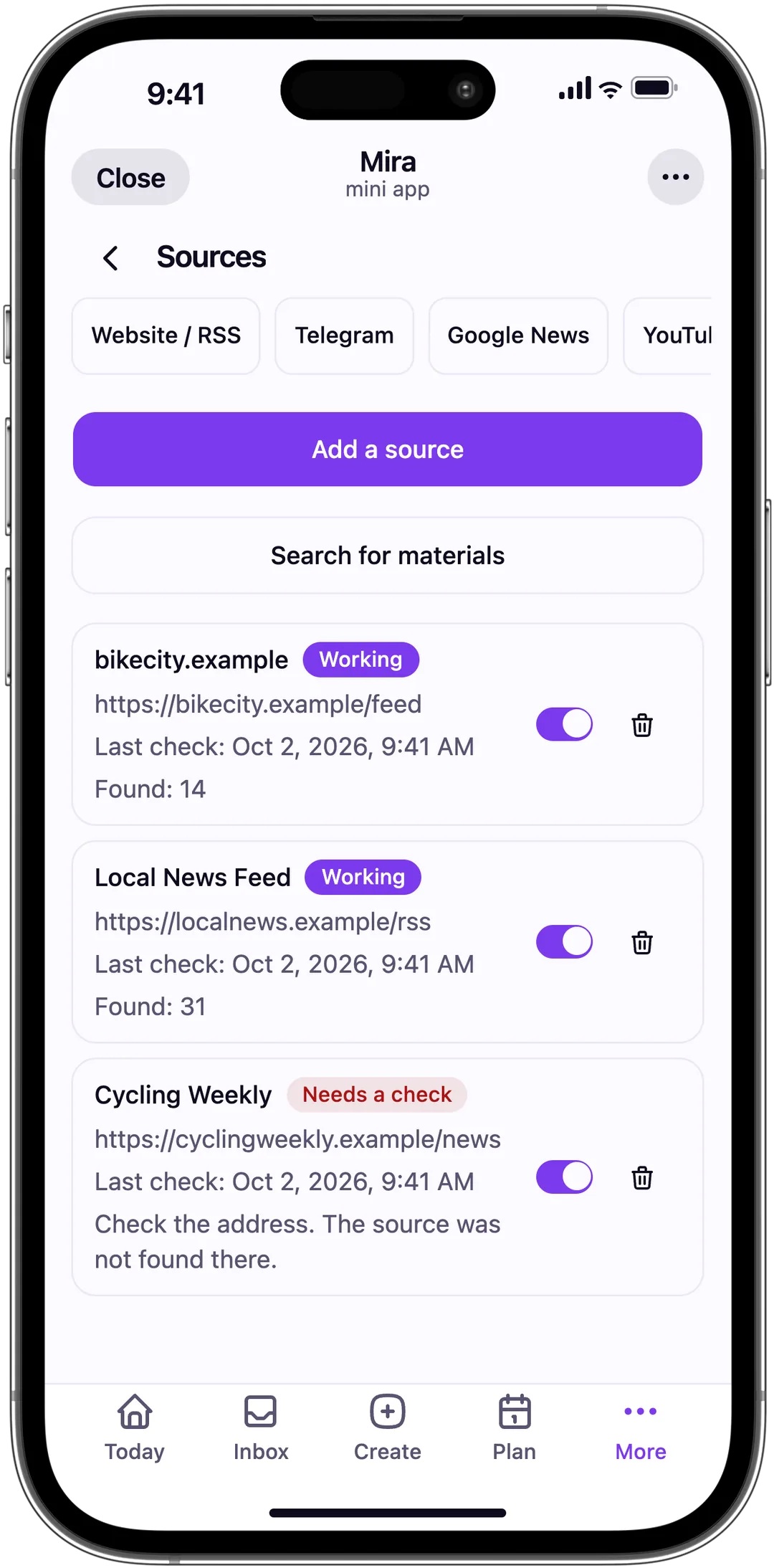
- Add a source. Open More, then Sources. Choose the type, enter the address and confirm.
- Watch the status. Each source shows a state, such as checking, working or needs attention.
- Fill in your Profile. Enter your topic, audience, tone and what to avoid.
- Connect your channel. Mira asks for it when you first publish or plan a post.
- Add the bot as admin. Give it the right to post messages.
If something is missing, Mira names it. It may say the bot is not an admin, or cannot post. Fix that in More, then Channel.
Review your first drafts
Start a search from Today. Mira collects new items, filters them and scores each against your Profile. The best ones land in your Inbox.
Each card shows the source, a short summary and the reason Mira chose it. Open one, edit the text, then publish it or plan it.
Nothing goes out until you approve it. That includes your first week, when you are still learning what your readers like.
Mira scores relevance. It does not check facts. If your name is on the channel, read the source before you publish.
Before-and-after post examples show how to make a draft easy to read.
Set your posting rhythm
Readers see posts in the order they arrive. Ten posts in one hour push each other down. The same ten posts spread across the day each get their own moment.
Pick the hours when your readers are awake. Use their time zone, not yours. You set your own time zone in More, then Account.
You have two ways to spread posts.
- Plan them by hand. Open a draft, choose a date and time and confirm. Plan shows posts by day.
- Use auto-publish on Pro. Set the posts per day, a time window and the lowest score. Mira spreads posts across the window.
Auto-publish works for website and Telegram sources only. Drafts from other sources wait for your approval.
Want to see this on your own topic? Add one source and read the first drafts.
Plan your first two weeks of posts in one table.
Find your first readers
The first readers are the hardest to find. Telegram offers only small discovery tools for a new channel.
Start with people who know you. Then recommend channels to each other with owners of nearby topics. Put the link in every profile you own.
Telegram Similar Channels picks channels by overlap of subscribers. It helps only after you have readers. Read our full guide on how to grow a Telegram channel.
Do not plan income yet. Ads and sponsors need an audience first.
Common mistakes
Publishing everything a feed sends
Ten feeds can produce a huge stream of items. Readers mute a channel that posts all of them. Filter by relevance, or approve each post yourself.
No point of view
A channel that only forwards links has no reason to exist. Add one line of your own. A short take gives readers a reason to follow you.
An uneven schedule
Three posts on Monday, none until Thursday, and twelve on Friday teach readers nothing. Pick a rhythm and keep it.
Copying a bigger channel
Forwarding everything from a larger channel makes yours redundant. Choose a narrower topic instead.
When this approach does not fit
If you write every story yourself, skip the source steps. Post by hand, and use Telegram's own scheduled messages. We explain that in how to schedule posts.
If you need every item from a source, such as official notices, do not filter. Use a plain feed bot.
Mira scores items first, so low-scored items sink in your Inbox.
However, if you pick stories from many sources every day, a tool saves hours.
Frequently asked questions
How many content sources do I need to start a news channel?
Start with three to five sources that cover your topic from different sides. You can add more later.
Too many sources at the start create noise before you know what your readers like. Mira Free follows up to 5 websites.
Should a Telegram news channel be public or private?
Public, in almost every case. A public channel has a username and appears in search. Anyone can join without an invite link.
New channels start private, so you must change this in the channel profile. Private fits gated content, such as a paid group.
Do I need to fact-check AI-picked content?
Yes, if your name is on the channel. Mira scores each item for relevance to your topic. It does not verify facts.
Read the source before you publish. Mira asks for your approval on every post, unless you turn on auto-publish on Pro.
Can I run a news channel without a bot?
Yes. You can write and post every story by hand. Telegram also schedules posts for you.
A tool helps when you pick stories from many sources every day. Then reading and choosing takes more time than writing. Start by hand if you are unsure.
How do I get the first subscribers?
Ask people who already know you. Then swap recommendations with owners of nearby channels.
Telegram Similar Channels can help later. It picks channels by overlap of subscribers, so it needs some readers first. Do not count on it in week one.
Your next step
Write your topic in two sentences today. Pick three sources that match it. Add the first one in Mira and read what lands in your Inbox.