Mira
MiraHow Often Should You Post on a Telegram Channel? Find Your Rhythm
Author: Mira TeamPublished: Updated:
- posting-frequency
- telegram
- analytics
TL;DR
- No public data gives one right number of posts. The answer depends on your channel type and your readers.
- More posts do not bring more readers. Past a point, readers mute the channel.
- Spread posts across the day. A batch of posts in one hour hides all but the last.
- Test your own rhythm for two weeks. Mira only enforces the schedule you choose, so skip it if you post rarely.
"How often should I post?" is the first question new channel owners ask. It assumes that frequency drives growth. It does not.
The better question is this: what rhythm keeps readers interested without pushing them to mute?
We do not give you a magic number. We could not find a source that proves one. This guide gives a method to find yours.
The trap of "more is better"
The idea is simple. More posts should mean more views, and more views should mean more growth. It sounds right, and it fails.
Posting more does not by itself show your channel to new people. It puts more items in front of the readers you already have. Each extra item asks for a bit more of their attention.
One reader pays for that attention in two ways. They skip your posts, or they mute the channel. Both cost you.
Muting is one tap. The reader stays subscribed, but the channel stops making notifications. Telegram's channels page says statistics show how many users join, leave and mute.
One industry write-up points the same way. Postmypost (2025) reports lower views per post as daily posts grow. It shares no sample size or method, so treat it as a hint, not proof.
AI drafts fast, but more posts do not mean better ones. See where AI helps and where it does not.
Frequency is only half of it. Read how to make each post easy to read.
What actually drives a channel
Frequency is one input, and rarely the strongest. Four other factors matter more.
- Quality of each post. One well-chosen story earns more reactions and forwards than five weak links.
- A steady topic. Readers joined for a subject. Drifting off it breaks the deal.
- A predictable rhythm. If posts arrive at similar times, readers learn when to look.
- Signs of life. Reactions, views and comments show readers that people care.
Forwards matter because they bring new readers. Telegram shows shares and reactions per post in its statistics. A post that people share can reach readers that a higher post count never will.
Telegram Similar Channels picks channels by overlap of subscribers. It does not measure how much you post.
Read the signals before you change anything
Your readers tell you when the rhythm is wrong. Telegram statistics show most signals. They appear only when a channel is large enough.
- Mutes rise. The mute graph and the share of readers with notifications on show this.
- Views per post fall. Subscribers stay flat, but fewer people open each post.
- Reactions drop. Posts similar to earlier hits get fewer reactions.
- Comments fade. Your linked group goes quiet.
- Leaves rise. A jump after you raised the volume is the clearest sign.
In a small channel, you may not have these graphs. Watch the view counter on each post instead. Compare views with your subscriber count over a few weeks.
Starting points by channel type
Channel types set different expectations. The table gives starting points, not benchmarks. We chose them from how each type is used, and we did not measure them.
| Channel type | Reader expects | Start with |
|---|---|---|
| News aggregator | Fresh stories through the day | Several posts a day, spread out |
| Niche expert | Depth in each post | One or two posts a day |
| Brand or company | Real news only | A few posts a week |
| Daily digest | A ritual | One post at a fixed time |
| Personal creator | A voice | Whenever you have something to say |
| B2B industry | Work-hour reading | Weekday posts in work hours |
Content density matters more than the label. A niche channel with a deep post twice a week can beat shallow daily posts.
Why even spacing beats bursts
Say you publish ten posts a day. You can spread them across twelve hours, or send them in one hour.
In the app, a channel's posts appear in the order you send them. A reader who opens Telegram after a burst sees a pile of unread posts. Many readers scroll past the pile.
Spread posts work differently. Each post arrives alone. A reader sees it with its own notification.
We expect this to help views per post. On the other hand, we have no data of our own to prove it. Test it in your statistics.
Time windows
Post when your readers are awake. Use their time zone, not yours.
If most readers live in one time zone, choose one window in daytime hours there. Telegram statistics include a graph of the hours when readers view posts.
If your readers live in several zones, pick the zone with most of them. Or split posts across two windows.
Night posts only make sense when your readers are awake at night. Weekends depend on your topic. A B2B channel may go quiet on Saturday, and a hobby channel may not.
Patterns that backfire
Following generic "best time" charts
Most charts come from other apps. They do not describe your readers. Use your own statistics.
Letting sources set your pace
A feed may drop thirty articles at midnight. Do not post thirty items at midnight. Keep collecting and publishing separate.
Buffer stories and send them on your own schedule.
Catching up after a break
A break followed by a pile of posts floods the readers who waited. Restart at your normal pace instead.
One format at one time
If every post in a slot is a bare link, readers skip the slot. Vary the format.
Find your own rhythm
Test your way to a rhythm. The process takes about a month.
- Start at the low end. Use the table above and pick the calmer option for your channel type.
- Hold it for two weeks. Do not change topics, formats or times during this period.
- Record three numbers. Note views per post, mutes and reactions. Use statistics, or the view counter in a small channel.
- Add one post a day. Keep everything else the same for two more weeks.
- Compare the numbers. If mutes rise or views per post fall, go back. The earlier rhythm was near your ceiling.
- Stay below the ceiling. Choose a rhythm a little lower, so a weak week does not push readers away.
We chose two weeks because readers need time to react. It is our rule of thumb. Adjust it if your channel is small and slow.
Write the rhythm down in a content plan template.
Where Mira fits
Mira does not decide how often you post. You do that with the method above. Mira enforces the rhythm you choose.
Mira collects items into the Inbox, so collecting stays separate from publishing.
On Pro, auto-publish takes three settings. They are posts per day, a time window and the lowest score. Mira spreads posts across the window instead of sending them together.
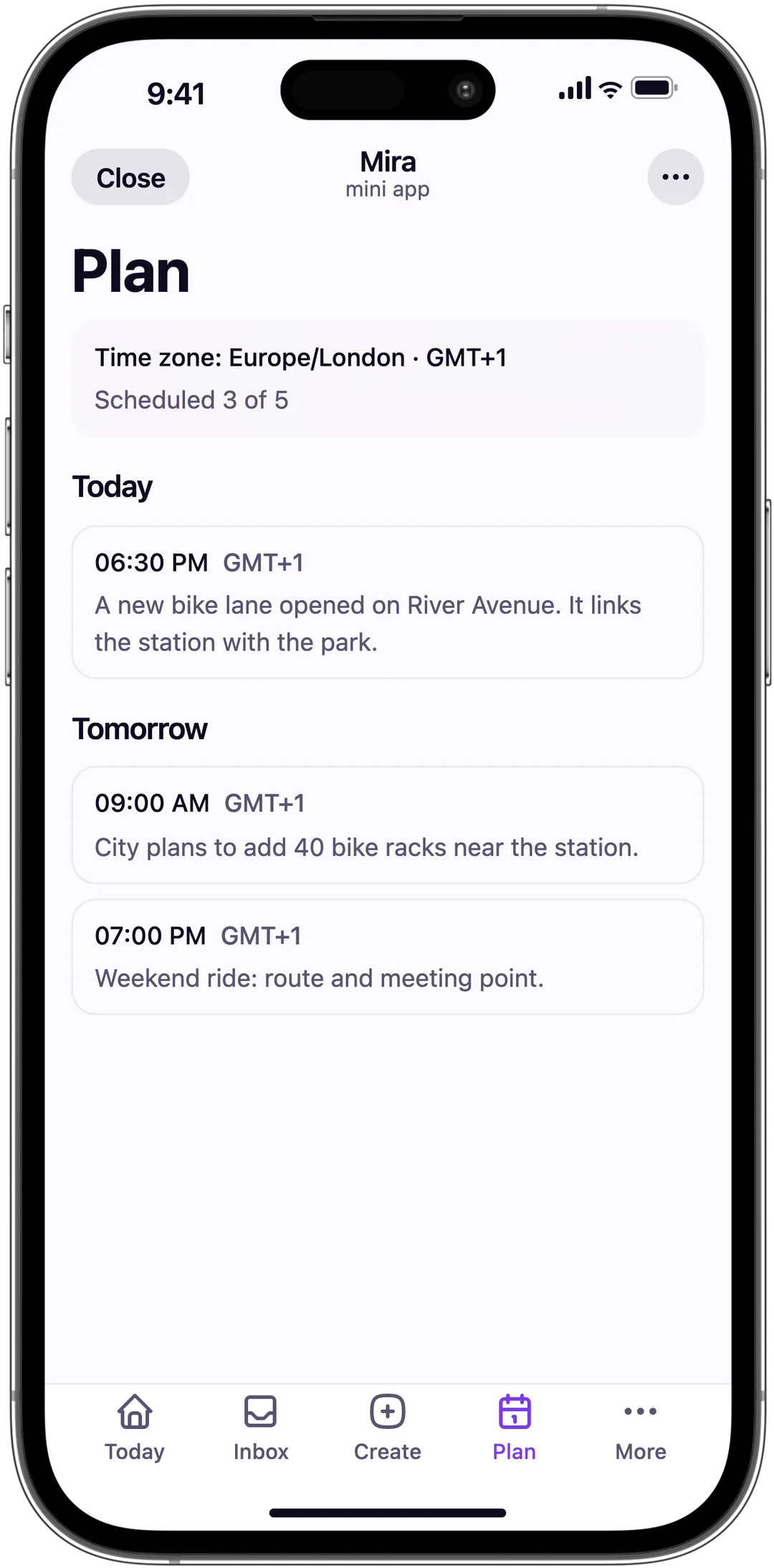
You can also plan posts by hand in Plan. Posts show by day, so gaps and clusters are easy to see. Pro costs 500 Telegram Stars, 690 RUB or 7 USDT per month.
Do you want your schedule to run without you?
Read how to schedule posts on a Telegram channel for the steps. For the source side, see how to auto-post RSS to Telegram.
When this does not apply
If you post a few times a week by hand, you do not need automation. Pick your days and write. Telegram can schedule each message for you.
If your channel posts every item from a source, the source sets the rhythm. Official notices are an example.
Frequently asked questions
What is the minimum posting frequency for a Telegram channel?
We found no public data for a minimum. Post as often as you can keep good quality.
A rhythm you can hold for months beats a burst you drop. If readers forget you between posts, add a fixed weekly post first.
Is there a perfect time to post on Telegram?
No time works for every channel. Post when your own readers are awake, in their time zone.
Telegram statistics include a graph of the hours when readers view posts. In a small channel, compare the view counters of your posts at different hours.
How long does it take to see if a rhythm works?
We suggest two weeks per change. Readers need time to react, and one change at a time shows the cause.
Keep topics, formats and times the same during the test. Then compare views per post, mutes and reactions. Change only one thing at a time.
Should weekend posts differ from weekday posts?
It depends on your readers. A work-related channel may go quiet on weekends, since readers read it at work.
A hobby or lifestyle channel may keep its weekend rhythm. Check your own views on weekends before you decide. Your statistics beat any general rule.
Does Telegram penalize over-posting?
We found no Telegram rule that punishes it. The cost comes from readers. They mute the channel, and views per post fall.
Statistics can show mutes and notifications. They appear only when a channel is large enough. Until then, watch views per post.
Our verdict
Choose a rhythm you can keep, and spread the posts out. Test one change at a time, and let your own statistics decide.
Pick your rhythm today, then let Mira hold it. Add one source and set a time window.