Mira
Telegram Content Calendar: a Free 30-Day Template and How to Fill It
Author: Mira TeamPublished: Updated:
- content-plan
- telegram-channel
- template
TL;DR
- The template has 30 numbered rows and 9 columns. Download it as CSV or XLSX.
- We advise 4–6 rubrics. Each rubric needs a known place where its materials come from.
- Plan 2 weeks ahead, not a month. Spend half an hour once a week to review and refill.
- Telegram can schedule single posts. Mira finds materials for news rubrics and for your links of the week. It keeps planned posts in Plan.
A Telegram content plan is a table of your next posts for the next two to four weeks. Each row is one post: date, time, rubric, topic, source, format and status. Below you get a free 30-day template and a filled example week. You also get a half-hour weekly routine that keeps the plan alive.
Mira (usemira.pro) is a Telegram bot that finds and drafts posts for a channel. We make Mira, so we are not neutral. The template works without Mira, in any spreadsheet app.
We checked the Telegram and Notion facts in this article on 2026-10-11. If you find an error, write to us via the contact page.
Download the template
The template has 30 rows: one month of slots. Fill 14 of them in detail and keep the rest as rubrics. Open it in Excel, Numbers, LibreOffice or any app that reads CSV.
- Content plan template, XLSX: four sheets. Plan has 30 rows and drop-down lists for Format and Status. Rubrics, Example week and Weekly check match the sections below.
- Content plan template, CSV: the Plan sheet only, for any tool that imports CSV.
Prefer to build it yourself? Copy this header row into a new sheet:
Day,Date,Time,Rubric,Topic (working title),Source or idea,Format,Status,Result note
Here is what goes into each column.
| Column | What to put | Example |
|---|---|---|
| Day | The slot number, 1 to 30 | 4 |
| Date | The publish date | Thu, 15 Oct |
| Time | The publish time in your readers' time zone | 09:00 |
| Rubric | The repeating type of post | Reader question |
| Topic (working title) | One line about the post | Why does my coffee taste sour? |
| Source or idea | Where the material comes from | A comment under last week's post |
| Format | Text, Photo + caption, Video, Poll or Digest | Text |
| Status | Idea, Draft, Scheduled or Posted | Draft |
| Result note | What happened after the post went out | Many replies, repeat the topic |
Two columns do most of the work. Source or idea tells you where to look before you sit down to write. Result note tells you which rubrics to keep.
A photo caption has its own limit. Telegram allows 1024 characters in a caption without Premium (caption_length_limit_default). Plan longer texts as Text posts.
Pick 4–6 rubrics
A rubric is a type of post that repeats on a set day. An example is "Reader question on Thursday". Rubrics turn "what do I post today?" into "which reader question do I answer?". That question is easier.
We advise 4–6 rubrics. Fewer makes the channel repeat itself. More makes the plan hard to fill. The tables below are our starting points, not measured norms.
News channel
New to this type? First read how to start a news channel.
| Rubric | Posts per week | Where materials come from |
|---|---|---|
| Main news | 5–7 | Websites and their feeds, Google News |
| "What it means" explainer | 1–2 | A news item plus your own notes |
| Weekly digest | 1 | This week's posts |
| Poll | 1 | A news item readers argue about |
Expert or author channel
| Rubric | Posts per week | Where materials come from |
|---|---|---|
| Tip or how-to | 2 | Your own work and notes |
| Industry news with your comment | 2 | Websites, YouTube channels |
| Answer to a reader question | 1 | Comments and messages |
| Case from your work | 1 | Your own work |
| Links of the week | 1 | Saved links from the week |
Niche hobby channel
| Rubric | Posts per week | Where materials come from |
|---|---|---|
| News and new gear | 2 | Websites, subreddits, YouTube |
| How-to | 2 | Your notes, videos you liked |
| Reader question | 1 | Comments |
| Poll | 1 | Your own idea |
| Weekly digest | 1 | This week's posts |
Our advice: give every rubric a source before you add it to the plan. A rubric with no source turns into an empty slot within two weeks. Write the rubrics with their sources on the Rubrics sheet of the template.
Fill the first two weeks in one sitting
Fill 14 days at once, then stop. Two weeks is enough to keep the channel going and short enough to change. These six steps take you from an empty sheet to a working plan.
- Choose how often to post. Pick a number you can keep for a month. Our guide on how often to post helps you choose.
- Fix the time slots. Give each post a fixed time, such as 09:00. Use your readers' time zone, not your own.
- Put rubrics on days. Give each rubric its own day, such as polls on Saturday. Readers learn what to expect.
- Write a working title in each row. One line is enough. You will polish it when you write the post.
- Add a source to each topic. Write a site, a video, a comment or "own notes". A row without a source is a warning sign.
- Set the status. Most rows start as Idea. Change the status as each post moves to Draft, Scheduled and Posted.
After step 6, each of the 14 days has a topic and a place to start. Keep empty rows for news that you cannot plan ahead.
For the Format column, see Telegram formatting styles and how to write a good Telegram post.
A worked example: one week of a home coffee channel
Here is one filled week. Example, not a real channel: "Home Coffee Notes", a niche channel about brewing coffee at home. It posts once a day.
| Day | Time | Rubric | Topic | Source or idea | Format | Status |
|---|---|---|---|---|---|---|
| Mon | 09:00 | News | A new budget grinder is announced: what we know | Website source: feed of a coffee review site | Photo + caption | Scheduled |
| Tue | 09:00 | How-to | Pour-over coffee in 5 steps for beginners | Own notes | Text | Draft |
| Wed | 09:00 | How-to | Dialing in espresso: a 10-minute video in 4 points | YouTube channel of a coffee reviewer | Text | Draft |
| Thu | 09:00 | Reader question | Why does my coffee taste sour? | A comment under last week's post | Text | Idea |
| Fri | 09:00 | News | What people discuss this week about cold brew | A coffee subreddit | Text | Idea |
| Sat | 12:00 | Poll | Which brew method do you use most? | Own idea | Poll | Draft |
| Sun | 10:00 | Digest | The week in 5 links | This week's posts | Digest | Idea |
Why the week looks like this:
- News sits on Monday and Friday. You cannot write news in advance. Those rows hold a source, not a finished text. The source fills them a day or two before.
- The weekend posts are lighter and later. A poll and a digest take little time to write. The later hours are our guess for this example: test your own times.
- Every row has a source. Even "own idea" counts. The Thursday row shows the best source of all: a question a reader already asked.
The Example week sheet in the template holds this same week.
Where ideas for each rubric come from
Each rubric has a natural source. The plan works when you know it in advance. Here are the places we suggest, by type of material.
- News and digests: websites and their feeds, YouTube channels, subreddits and Google News searches. Our guides show how to bring each into Telegram: RSS, YouTube, Reddit and Google News.
- Reader questions: comments under your posts and the messages people send you. Save good questions in the Source column the day you see them.
- Your own results: Telegram shows channel statistics to admins of channels above a certain size. It includes views, shares and reactions per post (Telegram API docs). Telegram does not publish the size threshold in those docs.
- Seasonal dates: holidays, events in your niche, the start of a season. Put them in the plan a month ahead.
This is where most plans break. The topic is planned, but on the day you have nothing to post. Mira closes this gap for the rubrics that need outside materials.
You describe your channel once in Profile: topic, audience, tone and what to avoid. You add sources in More, then Sources. Mira searches them and scores each item against your Profile. The best go into Inbox as drafts.
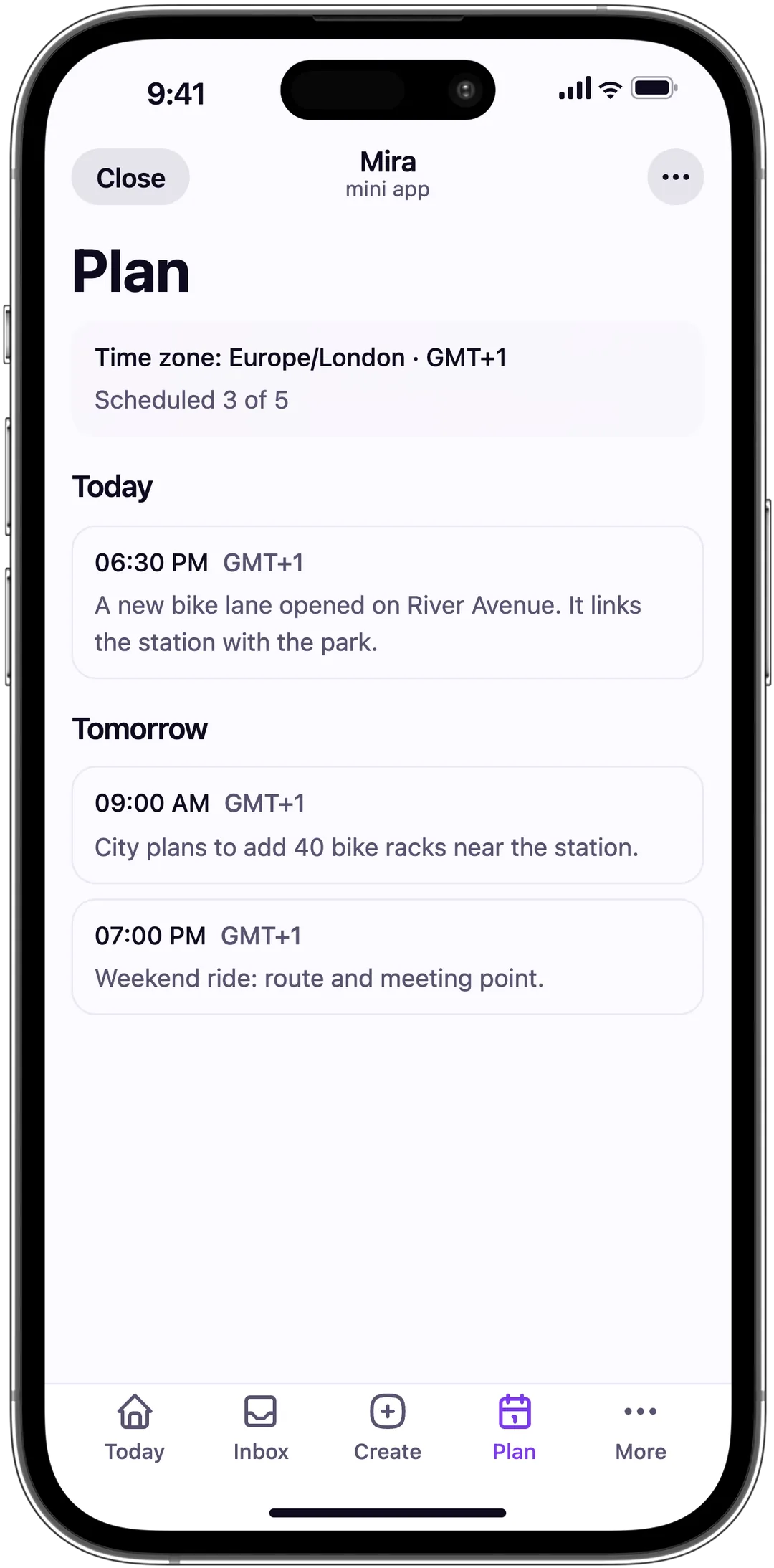
You open a draft, edit it and tap Schedule. The post appears in Plan, sorted by day. For idea rubrics, Create can write a draft from a topic you give it. Mira does not know your rubrics. You still decide which draft fills which row.
Want to try it on your news rubric? Add one source and see what lands in the Inbox.
Read more about each screen in How Mira works.
Keep the plan alive: a half-hour weekly routine
A plan stays useful only if you review it every week. Set half an hour on the same day, for example Friday afternoon. This checklist is also on the Weekly check sheet of the template.
- Write a result note for last week's posts. One line each: views, replies, anything unusual.
- Fill empty slots for the next 7 days. You always keep about two weeks planned.
- Move topics that are not ready. A topic with no material yet goes to a later date.
- Add new topics. Take them from comments, your sources and the seasonal dates.
- Remove a rubric that does not work. Our rule: if a rubric is weak for 3 weeks in a row, change it or drop it.
Where should the plan live? Each tool does a different part of the job.
| Tool | Good for | What it does not do | Cost |
|---|---|---|---|
| Spreadsheet (this template) | The whole plan in one view, notes, rubrics | Does not publish | Free apps exist |
| Notion | Plan plus drafts and links in one page | We found no built-in Telegram publishing | Free plan available (notion.com/pricing) |
| Telegram scheduled messages | Publishing a finished post at a set time | No overview of rubrics, no notes | Free, built into Telegram |
| Mira Plan | Finding materials, drafts and planned posts by day | No rubric or result columns | Free: up to 5 planned posts. Pro: up to 30, 500 Telegram Stars, 690 RUB or 7 USDT per month |
To schedule in Telegram itself, hold the send button and choose Schedule Message (Telegram blog). Telegram limits how many messages a chat can have scheduled and how far ahead. The API docs name these errors but do not give the numbers.
Our recommendation: keep the spreadsheet as the plan, and publish with a tool. Use Telegram scheduled messages if you write every post yourself. Use Mira if your news rubrics need fresh materials every week. It finds the items; you still write the digest.
Why a content plan stops working
Most plans fail for a few repeated reasons, and each has a simple fix.
- The plan covers a whole month in detail. News changes, and old rows feel wrong. Plan 2 weeks in detail and leave the rest as rubrics only.
- A rubric has no source. Every week you invent material from zero. Give each rubric a source, or drop it.
- Every post has the same format. Readers scroll past the same shape. Mix text with a photo, a poll or a digest.
- Nobody reads the result notes. The plan repeats weak rubrics forever. Use the weekly check to change one thing at a time.
- The plan has no free slots. A breaking story has nowhere to go. Keep one or two open slots each week.
Frequently asked questions
What should a Telegram content plan include?
At minimum: date, time, rubric, topic, source and status for each post. Our template adds the format and a result note.
The source column matters most. It tells you where to find the material before the day of the post.
How far ahead should I plan posts?
We advise 2 weeks in detail. Beyond that, keep only the rubrics and seasonal dates.
A longer detailed plan goes out of date, especially for news. Review and extend it by one week every week.
How many rubrics does a Telegram channel need?
We suggest 4–6. That gives variety without making the plan hard to fill.
Start with fewer if you post less than daily. Add a rubric only when you know where its materials come from.
Can I schedule posts from a content plan automatically?
Yes, in part. Telegram can schedule a single post: hold the send button and choose Schedule Message. Each post is a separate entry.
The Telegram API lets Premium users repeat a scheduled message. It repeats at fixed intervals, such as daily, weekly or yearly. We did not check which Telegram apps show this option.
In Mira, posts you schedule go out on their own, on Free too. Pro adds auto-publish: Mira posts drafts that pass your minimum score within your time window.
Where do I find ideas when I run out?
Look in three places: your sources, your comments and your past results. A question a reader asked is often the best next post.
Seasonal dates in your niche help too. If news rubrics run dry, add more sources rather than more rubrics.
Can AI make a content plan for my channel?
AI can suggest rubrics and topics. Check each one. A general AI tool does not know your readers or past results.
Mira works on the materials side. It searches your sources, scores items against your channel Profile and drafts posts. You still choose what goes into the plan. To see how AI helps run a channel, read how to run a channel with AI.
Start with next week
Download the template and fill the next 7 days today. Write a source in every row. In a week, run the half-hour check for the first time.
If your news rubric or links of the week have no source yet, give Mira that job. Add one source and plan its first draft for next week.